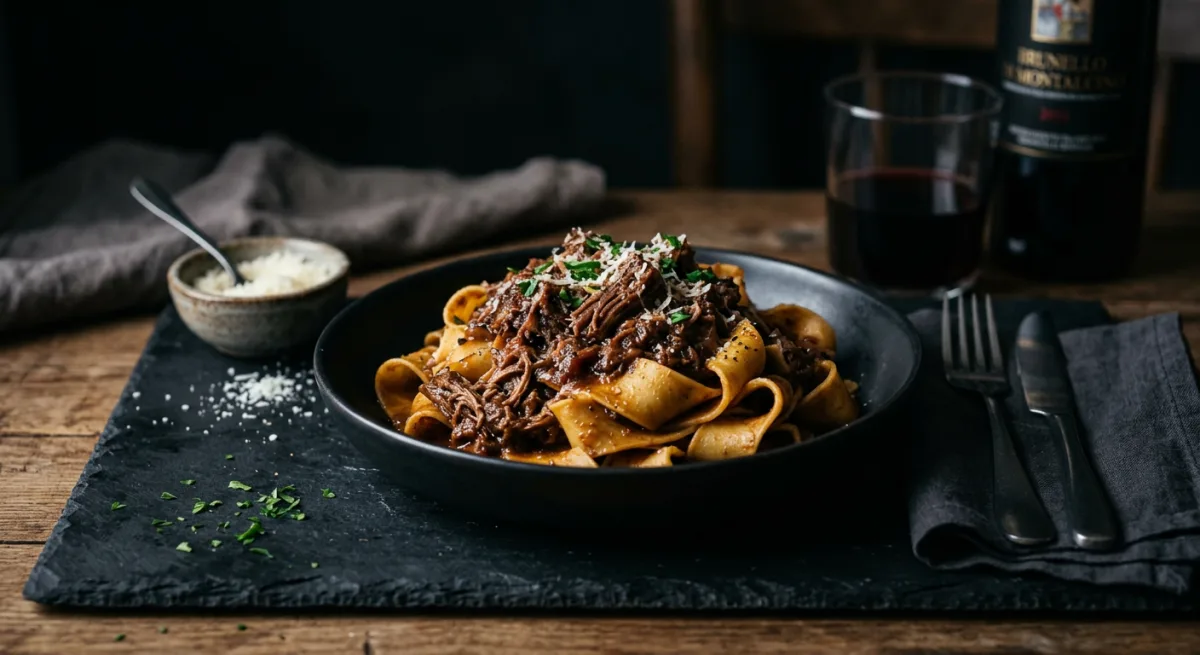
Ragù di Cinghiale su Pappardelle
A triumphant Tuscan wild boar ragù from the Maremma — bone-in boar shoulder braised for six unhurried hours in Brunello di Montalcino with juniper berries, rosemary, black peppercorns, and San Marzano tomatoes until the connective tissue surrenders entirely and the meat becomes an impossibly rich, complex, shredded masterpiece. The wine-dark sauce, deep with game and forest aromatics, is draped over hand-rolled bronze-die pappardelle, their rough surface and wide ribbons capturing every drop of the braise. This is a dish that demands patience and rewards it extravagantly.
Ingredients
1800 g wild boar shoulder (bone-in)
cut into 4 large bone-in chunks by butcher — do not debone, the bone adds enormous flavor to the braise
750 ml Brunello di Montalcino (or robust Tuscan Sangiovese)
full bottle — divided: 500 ml for marinade overnight, 250 ml for the braise
400 g San Marzano DOP tomatoes (canned)
hand-crushed with juices
30 g double-concentrated tomato paste
2 tablespoons
200 g white onion
roughly chopped
150 g carrot
roughly chopped
100 g celery stalks
roughly chopped
6 cloves garlic cloves
lightly crushed, skin on for the marinade — peeled and minced for the soffritto
3 sprigs fresh rosemary sprigs
left whole for the braise, removed before serving
4 sprigs fresh thyme sprigs
left whole for the braise
3 leaves bay leaves
fresh
12 berries juniper berries
lightly crushed in a mortar — this is the defining aromatic of wild boar cookery
8 peppercorns whole black peppercorns
lightly crushed
2 whole cloves
whole
400 ml wild boar or beef stock
warm
60 ml extra virgin olive oil
divided
10 g fine sea salt
for seasoning throughout
500 g dried pappardelle (bronze-die extruded)
or 600 g fresh hand-rolled pappardelle
80 g Parmigiano-Reggiano(optional)
finely grated, for serving — optional but traditional for finishing
10 g fresh flat-leaf parsley
finely chopped, for finishing
Prepare Steps
- 1
Overnight wine marinade(720m)
Place the wild boar chunks in a large non-reactive container or zip-lock bag. Add 500 ml of Brunello, the roughly chopped onion, carrot, and celery (half the soffritto vegetables), the skin-on crushed garlic cloves, 2 rosemary sprigs, bay leaves, juniper berries, peppercorns, and cloves. Toss well to coat. Cover and refrigerate for a minimum of 12 hours and up to 24 hours. The wine marinade tenderizes the meat, mellows the wild gaminess, and begins flavoring the flesh. When ready, remove the meat from the marinade and pat very dry with paper towels — do not rinse. Strain and reserve the marinade liquid; discard the soaked vegetables and aromatics (they have given all they have).
- 2
Prepare the fresh soffritto vegetables(8m)
Finely dice the remaining onion, carrot, and celery (fresh, not the marinated ones) into a uniform 3 mm brunoise. Mince the peeled garlic cloves. Having a fine soffritto (as opposed to the rough marinade vegetables) gives the final sauce a smooth, refined body.
Cook Steps
- 1
Sear the wild boar in batches(15m)
Preheat a large heavy Dutch oven (at least 6 liters) over high heat. Add 30 ml olive oil. Season the dried boar chunks aggressively with salt. When the oil is shimmering, sear the meat in two batches — never crowding the pan — for 3–4 minutes per side until a deep, almost black-brown crust forms on all surfaces. This Maillard crust is the backbone of flavor. Remove each batch and set aside. Pour off excess fat, leaving a thin film.
- 2
Cook the soffritto(20m)
Add 30 ml fresh olive oil to the Dutch oven over medium heat. Add the finely diced fresh onion, carrot, and celery. Scrape up all the dark fond from the seared meat. Cook for 12–14 minutes, stirring frequently, until deeply golden and caramelized — this is a dark soffritto, not a blond one. Add the minced garlic and cook 3 minutes. Add the tomato paste and stir continuously for 3 minutes until it turns brick-red and slightly caramelized, coating all the vegetables.
- 3
Deglaze and build the braise liquid(10m)
Add the remaining 250 ml of fresh Brunello to the pot and raise heat to high. Stir vigorously for 3 minutes, scraping every bit of fond from the bottom, until the wine reduces by half. Now add the strained marinade liquid and bring to a boil. Allow to reduce for 5 minutes — burning off residual alcohol. Add the crushed San Marzano tomatoes with their juices, the warm stock, remaining rosemary and thyme sprigs. Stir well.
- 4
Six-hour braise(360m)
Return all the seared boar chunks to the pot. The liquid should reach halfway up the meat — add stock if needed. Bring to a vigorous simmer, then reduce to the absolute lowest heat on your smallest burner, or transfer to a 150°C oven. Cover the pot with a tight-fitting lid and braise for a minimum of 5.5 to 6 hours. At the 3-hour mark, check the liquid level and add a splash of stock if the braise is reducing too aggressively. The boar is ready when the meat falls effortlessly away from the bone at the touch of tongs and a strand, when pulled, stretches and tears without any chew. The braise liquid should be dark, wine-red, and deeply aromatic.
- 5
Shred the meat and reduce the sauce(20m)
Remove the boar chunks to a cutting board. Remove and discard all herb sprigs, bay leaves, and bones. Using two forks, shred the meat into generous irregular pieces — not mince, not pulled-pork fine. Leave some larger chunks for textural contrast. Skim excess fat from the braising liquid. Return the pot to medium-high heat and reduce the sauce for 10–15 minutes until thick, glossy, and intensely flavored. Return the shredded meat to the reduced sauce. Taste and adjust salt. The ragù can rest for up to 30 minutes, covered, before serving — it only improves.
- 6
Cook the pappardelle and combine(10m)
Bring a large pot of generously salted water (18 g salt per liter) to a rolling boil. Cook the bronze-die pappardelle according to package directions minus 90 seconds for al dente — typically 8–9 minutes for dried, 3–4 minutes for fresh. Reserve 200 ml pasta water. Drain and transfer directly to the ragù pot. Toss over medium heat for 90 seconds, adding pasta water as needed to achieve a sauce that clings without being soupy. Every ribbon of pappardelle should be thoroughly coated in the dark, wine-rich ragù.
Serve Steps
- 1
Plate the pappardelle(1m)
Using tongs, twirl a generous portion of pappardelle into a loose, high nest in the center of each wide, warmed pasta bowl. Spoon additional ragù over and around the nest, ensuring several large pieces of boar are prominently visible on top. The sauce should pool slightly around the base of the pasta.
- 2
Finish and serve(30s)
Finish each bowl with a scattering of finely chopped flat-leaf parsley and, if desired, a light dusting of finely grated Parmigiano-Reggiano. Drizzle very lightly with a few drops of raw extra virgin olive oil. Serve immediately with an open bottle of the remaining Brunello or a robust Chianti Classico Riserva.