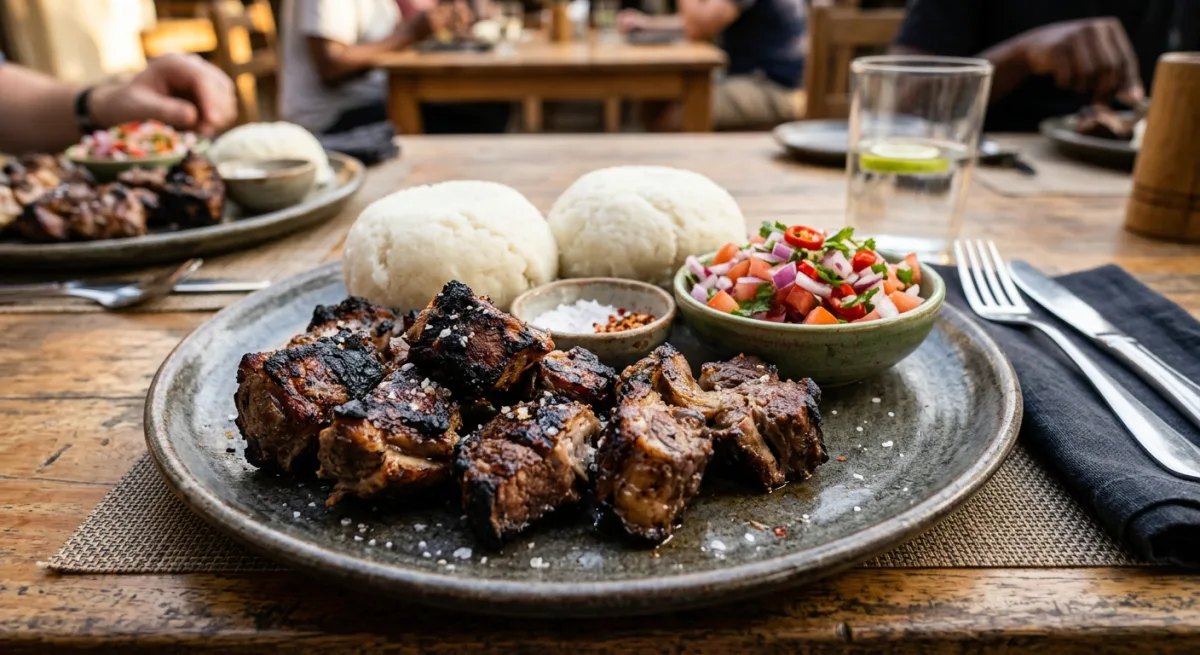
Nyama Choma (Charcoal Grilled Meat)
The soul of Tanzanian celebration — goat or beef kissed by nothing but coarse salt and the slow, patient heat of hardwood charcoal until the exterior is deeply charred and smoky while the interior remains succulent and juicy. This is communal eating at its most primal, served alongside bright kachumbari and pillowy ugali to soak up every drop of rendered fat and smoky juice. A dish that needs no embellishment because the fire itself is the seasoning.
Ingredients
2.5 kg bone-in goat shoulder or leg pieces
cut into large bone-in pieces approximately 200g each, sinew left on
25 g coarse sea salt
distributed evenly over all surfaces
500 g white maize meal (sembe)
for ugali — sifted
1.2 litre water
for ugali — brought to a rolling boil
5 whole ripe tomatoes
finely diced, seeds removed
2 whole white onion
finely diced
30 g fresh coriander
leaves and tender stems roughly chopped
3 whole fresh green chili
thinly sliced into rounds
2 whole lemon
freshly squeezed, seeds removed
8 g salt for kachumbari
4 kg hardwood charcoal or wood logs (acacia or mango wood preferred)
arranged in a two-zone fire — one side high heat, one side indirect
Prepare Steps
- 1
Salt the Meat(10m)
Pat the goat pieces completely dry with paper towels to remove all surface moisture. This is critical — moisture is the enemy of char. Sprinkle 25g coarse sea salt evenly over every surface, pressing it gently into the flesh and around the bones. Do not rub aggressively. Set pieces on a wire rack and refrigerate uncovered for a minimum of 2 hours, or overnight if time allows. The salt will draw out and reabsorb moisture, seasoning deeply.
- 2
Build the Fire(40m)
Light the hardwood charcoal or wood in a chimney starter. Allow it to burn until fully ashed over with no visible flames — approximately 30-40 minutes. This is non-negotiable; raw flame produces acrid, sooty smoke. Arrange the coals in a two-zone setup: a dense, high pile on one side for searing, and a sparse single layer on the other for slow indirect cooking. The indirect side should hold 150-170°C.
- 3
Make the Kachumbari(8m)
Combine diced tomatoes, onion, sliced green chili, and chopped coriander in a bowl. Season with salt and squeeze over the lemon juice. Toss well. Taste — the balance should be bright, acidic, and slightly sharp. Set aside at room temperature for at least 30 minutes before serving so the salt draws out the vegetable juices and the flavours meld. Do not refrigerate.
Cook Steps
- 1
Sear Over Direct Heat(15m)
Remove the meat from the refrigerator 30 minutes before cooking. Place pieces directly over the hot coals. Allow each side to sear undisturbed for 4-5 minutes until deep char marks form and the surface fat begins to render and blister. Do not move or press the meat during searing — patience creates the crust. Turn and repeat on all exposed surfaces.
- 2
Slow Cook Over Indirect Heat(80m)
Move all seared pieces to the indirect side of the grill. Cover with the grill lid or a sheet of foil tented loosely. Cook at 150-170°C for 60-80 minutes, turning every 20 minutes, until a probe thermometer inserted near the bone reads 82°C and the meat yields gently when pressed. Add fresh coals from the chimney as needed to maintain temperature. The fat should be fully rendered and the surface deeply mahogany-brown.
- 3
Cook the Ugali(30m)
Bring 1.2 litres of water to a vigorous boil in a heavy-bottomed pot. Add a pinch of salt. Begin adding the maize meal in a slow, steady stream while whisking continuously to prevent lumps forming. Once all the meal is incorporated, switch to a wooden spoon and stir vigorously. Reduce heat to medium-low. Continue stirring and folding the ugali every 2-3 minutes for 20-25 minutes until it pulls cleanly away from the sides of the pot and has a smooth, dense, non-sticky texture. Cover and rest 5 minutes.
- 4
Final Char and Rest(8m)
Return the slow-cooked meat briefly to the direct coals for a final 2 minutes per side to refresh the char and render any remaining surface fat to a crackling crust. Transfer to a wooden board and allow to rest uncovered for 8 minutes. Do not tent with foil — the steam will soften the exterior crust.
Serve Steps
- 1
Plate Communally(2m)
Arrange the nyama choma pieces directly on a large wooden board or banana leaf-lined platter without cutting — guests tear pieces apart at the table. Mound the ugali on a separate plate; use a wetted bowl to shape individual domes. Spoon the kachumbari into a serving bowl. Place a wedge of lemon alongside. Serve immediately while the meat is still steaming — nyama choma waits for no one.