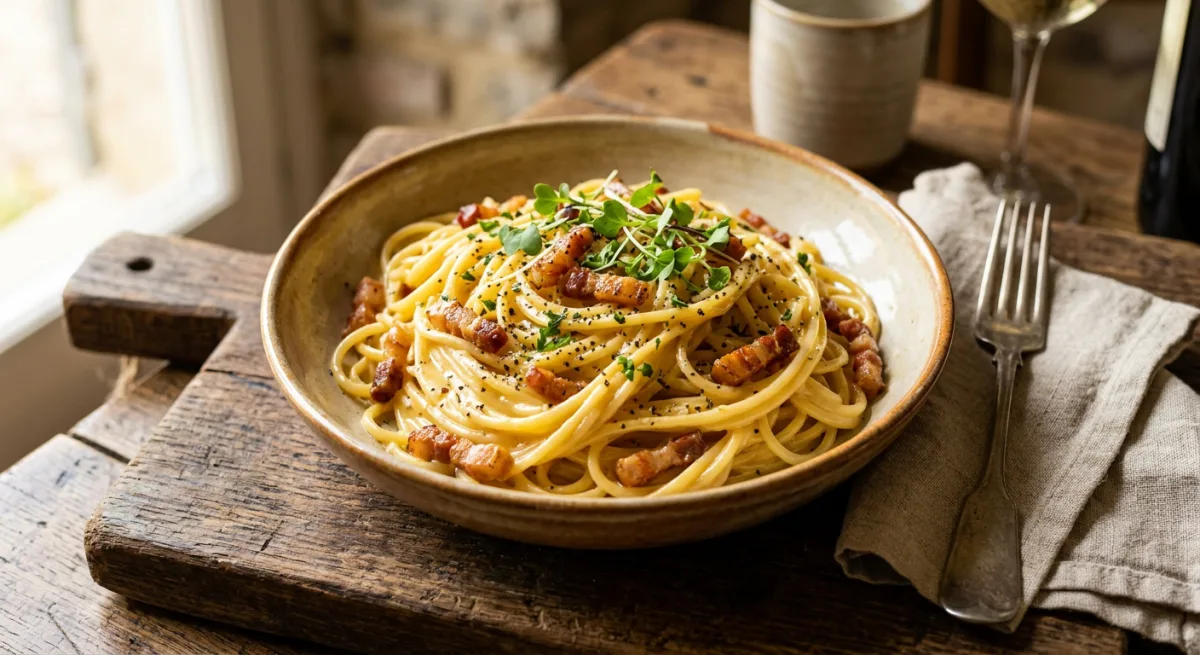
Spaghetti alla Carbonara
Rome's most debated and beloved pasta — silken strands of spaghetti coated in an impossibly creamy sauce made with no cream whatsoever, relying instead on the precise emulsification of eggs, aged Pecorino Romano, and starchy pasta water. The sauce clings to every strand, punctuated by amber shards of crispy guanciale and a fierce grinding of black pepper that defines the dish.
Ingredients
200 g spaghetti
dry weight
150 g guanciale
rind removed, cut into 1cm lardons
4 whole egg yolks
room temperature
1 whole whole egg
room temperature
80 g Pecorino Romano
finely grated on a microplane
20 g Parmigiano-Reggiano
finely grated on a microplane
20 g coarse sea salt
for pasta water
5 g black pepper
freshly and coarsely cracked in a mortar
Prepare Steps
- 1
Make the Egg and Cheese Mixture(5m)
In a medium bowl, whisk together 4 egg yolks and 1 whole egg until fully combined. Add 80g finely grated Pecorino Romano and 20g Parmigiano-Reggiano. Mix vigorously with a rubber spatula until the mixture becomes a thick, pale yellow paste. Season with half the cracked black pepper. Set aside at room temperature — cold egg mixture is the enemy of smooth carbonara.
- 2
Crack and Toast the Black Pepper(2m)
Using a mortar and pestle, crack the black peppercorns to a coarse, uneven grind — some larger shards, some fine dust. This textural variation is deliberate. Toast the cracked pepper in a dry skillet over medium heat for 45–60 seconds until fragrant and slightly smoky. Remove immediately and reserve.
- 3
Boil the Pasta Water(10m)
Bring 3 litres of water to a rolling boil in a large pot. Add 20g coarse sea salt — the water should taste pleasantly salty, like mild sea water. Do not add oil. Have a heatproof mug or ladle ready to reserve pasta water before draining.
Cook Steps
- 1
Render the Guanciale(12m)
Place the guanciale lardons in a cold, dry skillet (no oil needed — the fat content is sufficient). Set over medium-low heat. Cook slowly for 10–12 minutes, stirring occasionally, until the fat has fully rendered and the lardons are deeply golden and crispy on the outside with a slightly chewy center. Remove from heat but keep the skillet with all the rendered fat — this is flavour. Do not discard the fat.
- 2
Cook the Spaghetti(8m)
Drop 200g spaghetti into the vigorously boiling salted water. Cook for 2 minutes less than the package's al dente instruction — typically 7–8 minutes for standard spaghetti. The pasta will finish cooking in the sauce. Before draining, use a heatproof mug to scoop and reserve 200ml of the cloudy, starchy pasta water.
- 3
Temper the Egg Mixture(2m)
Remove the skillet of guanciale from the heat and allow to cool for 60 seconds — this is critical. If the pan is too hot, the eggs will scramble. Add 2 tablespoons (30ml) of reserved pasta water to the egg-cheese mixture and whisk briskly to loosen. Drain the spaghetti and immediately add it to the guanciale skillet off the heat. Toss rapidly with tongs to coat every strand in the rendered fat.
- 4
Emulsify the Carbonara Sauce(2m)
Pour the egg-cheese mixture over the spaghetti in the off-heat skillet. Toss constantly and aggressively with tongs using a lifting, folding motion — never stir in circles. Add reserved pasta water one splash (20–30ml) at a time as needed to achieve a glossy, fluid sauce that coats the pasta without running off. The target consistency is a silky, clinging emulsion that is creamy but not wet. This process takes 1–2 minutes of active tossing. If the sauce thickens too much, add another splash of pasta water. If it looks soupy, toss faster — the heat of the pasta will tighten it.
Serve Steps
- 1
Plate and Finish(1m 30s)
Use tongs and a ladle to twist the spaghetti into a high, tight nest in the center of each warm, wide bowl — warmed bowls are non-negotiable to prevent the sauce from seizing. Spoon any remaining sauce from the pan over each portion. Finish with a generous crack of toasted black pepper — carbonara should be fiercely peppery. Add an extra pinch of grated Pecorino Romano and serve immediately before the sauce cools.