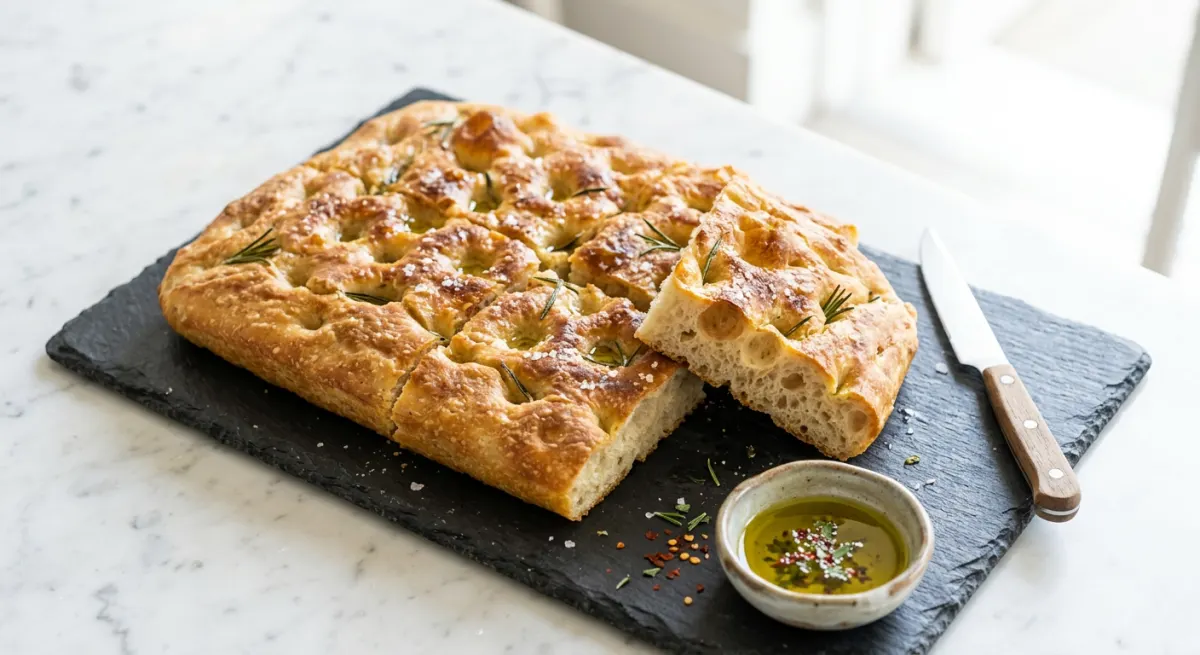
Focaccia Genovese
The Ligurian original — a thick, dimpled flatbread with a lacy, golden crust that shatters on the outside and yields to an impossibly tender, pillowy, olive-oil-soaked interior. Made using a slack, high-hydration dough stretched onto an oil-pooling sheet pan, then pressed with all ten fingers to create the characteristic craters that trap herb-scented brine before baking.
Ingredients
500 g bread flour
sifted
12 g fine sea salt
for the dough
7 g instant dry yeast
one standard sachet
400 ml lukewarm water
38–40°C
120 ml extra virgin olive oil
divided: 30ml for dough, 60ml for pan, 30ml for brine topping
8 g coarse sea salt or flaky salt
for topping
6 sprigs fresh rosemary sprigs
leaves stripped from stems
30 ml water
lukewarm, for brine topping
Prepare Steps
- 1
Mix the Dough(5m)
In a large bowl, whisk together 500g bread flour, 12g fine salt, and 7g instant yeast. Add 400ml lukewarm water and 30ml olive oil. Mix with your hands or a wooden spoon until a shaggy, rough dough forms — this is a high-hydration dough, 80% hydration, and will feel sticky and wet. Do not add more flour. This hydration level is what creates the open, airy crumb.
- 2
Develop with Stretch and Fold(120m)
Instead of traditional kneading, perform 4 sets of stretch and folds at 30-minute intervals. For each set: wet your hand, grab the underside of the dough from one side, stretch it up as high as it will go without tearing, and fold it over to the opposite side. Rotate the bowl 90° and repeat 4 times per set. Cover with a damp towel between sets. The dough will go from rough and shaggy to smooth, elastic, and developed.
- 3
First Pan Rest(30m)
Pour 60ml of olive oil into a 30x40cm rimmed sheet pan and spread it to coat the entire surface generously — Genovese focaccia should sit in a pool of oil, not just be greased. Scrape the dough onto the oiled pan, flip it once to coat both sides, then use flat-palmed hands to gently press and stretch it toward the pan edges. It will resist and spring back — that is normal. Cover loosely with plastic wrap and rest for 30 minutes. The dough will relax and spread further.
- 4
Preheat and Second Rest(20m)
Preheat oven to 220°C (430°F) conventional with a rack in the lower-middle position. After the 30-minute pan rest, gently stretch the dough again to fill the pan corners — it should now cooperate. Scatter fresh rosemary leaves evenly across the surface. Allow to rest uncovered for a final 20 minutes while the oven preheats. The dough will puff slightly.
Cook Steps
- 1
Dimple the Dough(2m)
Mix 30ml olive oil with 30ml lukewarm water and a pinch of fine salt to make the brine topping — whisk vigorously until combined into an emulsion. Pour the entire brine over the focaccia surface. Now, using all ten fingers, press firmly and deeply into the dough in a rhythmic, confident motion — create deep dimples across the entire surface, pressing all the way to the pan floor. The dimples will fill with the olive oil brine. Do not be gentle; the dimples are the signature of proper Genovese focaccia.
- 2
Scatter Salt and Bake(25m)
Immediately scatter 8g of coarse or flaky sea salt evenly across the dimpled, brine-pooling surface. Place in the preheated 220°C oven on the lower-middle rack. Bake for 22–25 minutes, rotating the pan 180° at the halfway point, until the top is deep golden brown and the underside is crisp and amber when lifted with a spatula. The focaccia should be golden on both top and bottom — check the base at 20 minutes.
Serve Steps
- 1
Cool Slightly and Slice(7m)
Remove the focaccia from the oven and allow it to cool in the pan on a wire rack for exactly 5 minutes — no longer, or the base will steam and soften. Run a palette knife or thin spatula around all four edges to loosen, then slide the focaccia onto the wire rack. The base should be crisp and golden. Slice into generous rectangles with a sharp bread knife or scissors. Serve warm for maximum enjoyment — the crust is at its crispest in the first 20 minutes.