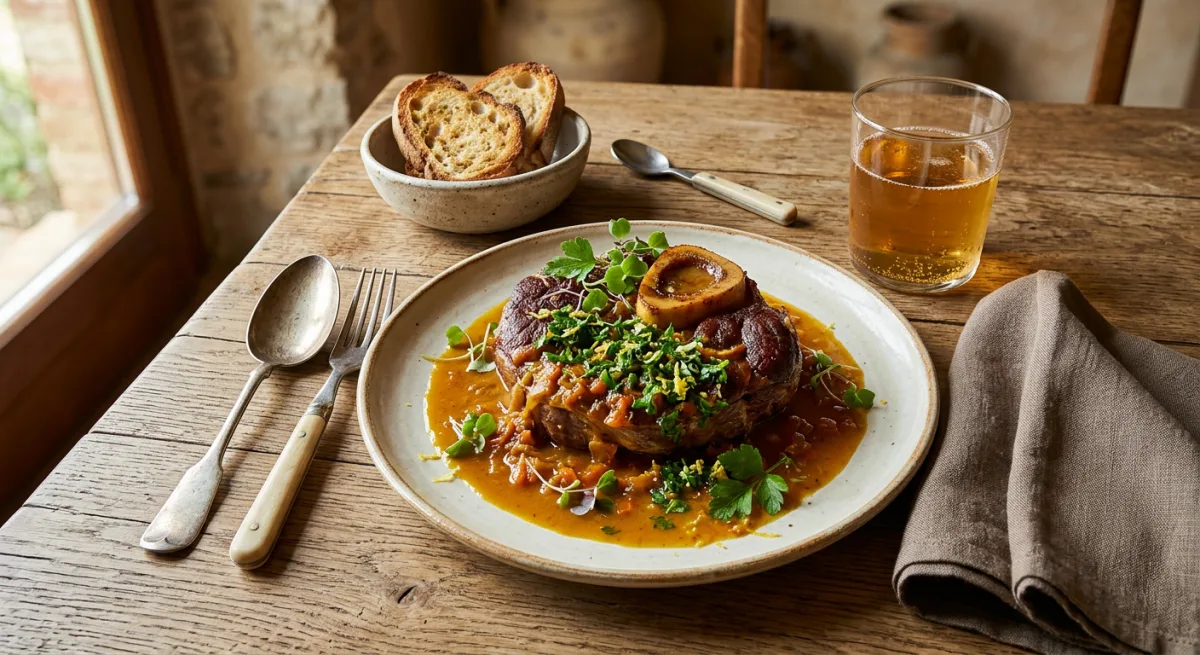
Ossobuco alla Milanese con Gremolata
Milan's crown jewel of braised cookery — thick cross-cut milk-fed veal shanks seared to a mahogany crust, then surrendered to a slow braise in dry white wine, saffron-gilded veal broth, and a fragrant soffritto of celery, carrot, and onion until the collagen dissolves into a lustrous, clinging glacé that coats the back of a spoon. The marrow in the bone's cavity — la midolla — is the chef's reward, scooped with a narrow spoon and spread on toasted bread. A final scattering of bright gremolata cuts through the richness with the snap of lemon zest, raw garlic, and flat-leaf parsley.
Ingredients
1600 g milk-fed veal ossobuco (cross-cut shank)
4 pieces, each 4–5 cm thick, about 400 g each — tie kitchen twine around the circumference of each piece to hold shape during braising
60 g rice flour (for dredging)
seasoned with 2 g salt and 1 g white pepper — use rice flour for a gluten-free and lighter crust
200 g white onion
finely diced (3 mm)
120 g celery stalks
finely diced (3 mm), leaves reserved for garnish
100 g carrot
finely diced (3 mm)
3 cloves garlic cloves
minced
250 ml dry white wine (preferably Pinot Grigio or Vernaccia)
room temperature
500 ml high-quality veal or chicken stock
warm — saffron threads steeped in 50 ml warm stock for 15 minutes before use
0.5 g saffron threads
steeped in 50 ml warm stock for 15 minutes to bloom
120 g San Marzano tomato (canned)
crushed, about 3 tablespoons — used only for color and very subtle depth, not a tomato-forward dish
40 g clarified butter
for searing
30 ml extra virgin olive oil
for soffritto
4 sprigs fresh thyme sprigs
tied into a bouquet with bay leaves
2 leaves bay leaves
fresh, included in herb bouquet
8 g fine sea salt
for seasoning
2 g white pepper
freshly ground
20 g flat-leaf parsley
very finely minced for gremolata — use only leaves, no stems
1 whole lemon (unwaxed)
zest only, finely grated on a microplane for gremolata — zest just before serving
1 clove garlic clove (for gremolata)
very finely minced or microplaned for gremolata — use raw, not cooked
Prepare Steps
- 1
Truss and season the shanks(30m)
Using kitchen twine, tie a single loop around the circumference of each veal shank, passing between the bone and meat, to prevent the meat from separating from the bone during the long braise. Season generously on all sides with 6 g fine sea salt and white pepper. Allow the shanks to rest at room temperature for 30 minutes before searing — cold meat steams rather than sears.
- 2
Bloom the saffron(15m)
Place 0.5 g saffron threads in a small bowl and add 50 ml of warm (not boiling) veal stock. Steep for at least 15 minutes — the liquid will turn deep amber-gold. This method extracts the full color, flavor, and aroma compounds from the saffron. Set aside.
- 3
Prepare the gremolata(5m)
Combine 20 g very finely minced flat-leaf parsley, the finely grated zest of 1 unwaxed lemon (microplaned directly into the bowl to capture the essential oils), and 1 microplaned raw garlic clove in a small bowl. Mix gently. Prepare this no more than 30 minutes before serving — the freshness degrades quickly. Keep covered in the refrigerator.
Cook Steps
- 1
Dredge and sear the veal shanks(10m)
Heat a large, heavy-bottomed braising pan or Dutch oven (28–30 cm) over high heat. Add 40 g clarified butter. Dredge each shank lightly in seasoned rice flour, shaking off all excess — the coating should be paper-thin, not thick. When the butter is shimmering and just beginning to smoke, place the shanks in the pan standing upright (marrow-side up is acceptable). Do not crowd — sear in two batches if necessary. Sear for 4 minutes per side, without moving, until deeply mahogany on both flat faces. Do not sear the cylindrical edges. Remove shanks and set on a plate.
- 2
Build the soffritto(14m)
Reduce heat to medium. Discard excess fat, leaving just a thin film in the pan. Add 30 ml extra virgin olive oil. Add the diced onion, celery, and carrot. Cook, stirring frequently and scraping up the brown fond from the seared veal, for 10–12 minutes until the vegetables are fully softened, sweet, and beginning to turn golden at the edges. Add the minced garlic and cook 2 more minutes. Season with a pinch of salt.
- 3
Deglaze and build the braise(7m)
Increase heat to medium-high. Pour in 250 ml white wine, scraping the bottom of the pan vigorously to lift all the caramelized fond — this is flavor. Allow the wine to reduce by two-thirds, about 4 minutes, until the raw alcohol smell has dissipated and the liquid is syrupy. Add the crushed San Marzano tomatoes and stir. Add the saffron-steeped stock plus the remaining 450 ml plain warm stock. Add the herb bouquet. Bring to a gentle simmer.
- 4
Low and slow braise(150m)
Return the seared veal shanks to the braising liquid, standing them upright with the marrow cavity facing up to keep the marrow in place during cooking. The liquid should come two-thirds up the shanks — add a little more stock if needed, never more than that. Cover the Dutch oven with a tight-fitting lid, reduce heat to the lowest simmer possible (or transfer to a 160°C oven), and braise for 2 hours without lifting the lid. After 2 hours, check: the meat should be very tender and beginning to pull away from the bone but not yet falling apart. Continue for a further 30–45 minutes if needed, checking every 20 minutes. The ideal ossobuco offers slight resistance at first bite then surrenders completely — it must not be falling-apart stew.
- 5
Reduce and finish the glacé(18m)
Remove the shanks carefully with a wide spatula and set aside on a warm tray, covered loosely with foil. Remove and discard the herb bouquet. Strain the braising liquid through a fine-mesh sieve into a wide saucepan, pressing the softened vegetables through the sieve with a ladle back — this adds body. Bring the strained sauce to a brisk simmer over medium-high heat and reduce for 10–15 minutes until it becomes a glossy, lightly napping glacé that coats a spoon cleanly. Taste and adjust salt. Return the shanks to the sauce, remove the kitchen twine, and gently baste to warm through over low heat for 3 minutes.
Serve Steps
- 1
Plate the ossobuco(1m)
Spoon a generous puddle of the saffron glacé onto the center of a wide, warmed rimmed plate. Set the veal shank standing upright in the center of the sauce — the exposed marrow bone should be visible and inviting. Spoon additional glacé over and around the shank.
- 2
Apply the gremolata and serve(30s)
Scatter a generous pinch of freshly made gremolata directly onto the exposed marrow and over the surface of the meat. The raw lemon zest and garlic must be applied at the last possible second — it is a condiment, not a garnish, and its brightness is the counterpoint to the rich braise. Serve immediately alongside classic saffron risotto alla Milanese and provide a marrow spoon for the bone. The marrow — la midolla — is considered the ultimate prize of the dish.