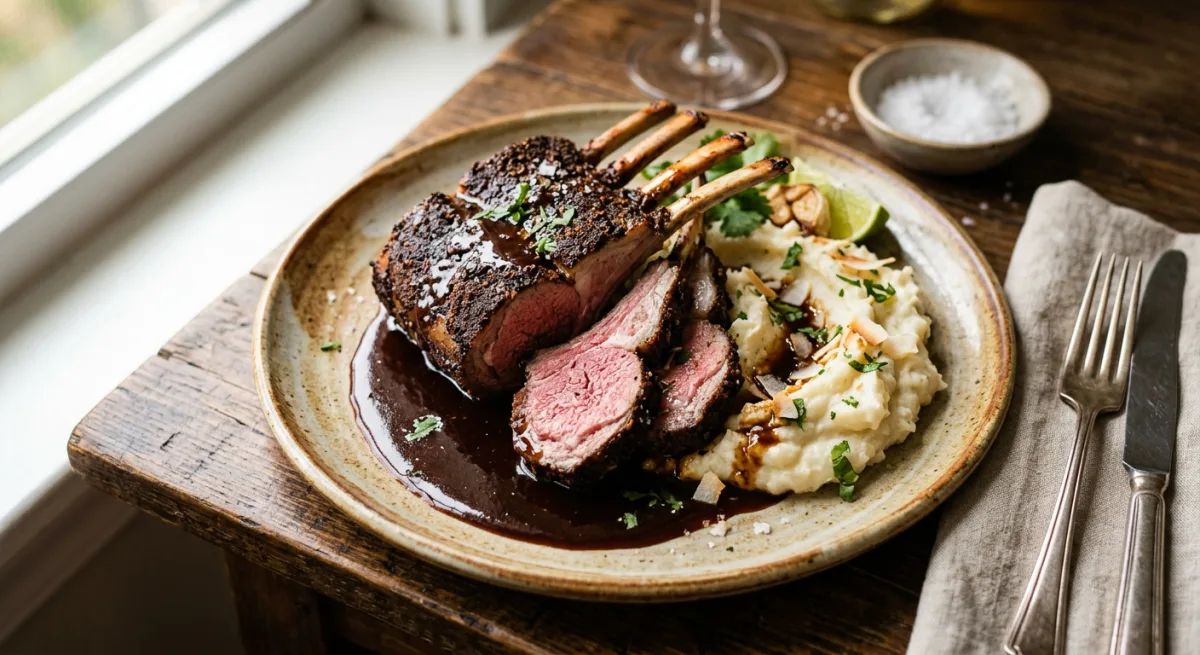
Zanzibari Spice Rubbed Lamb Rack na Mchuzi wa Tamarind
A French-trimmed rack of lamb, its bones gleaming and its crust black with toasted Zanzibar spices, reverse-seared to a perfect blushing rose and rested until the juices redistribute into every fibre. A luxurious tamarind reduction — deep, sweet-sour, and glossy as lacquer — anchors the plate alongside cloud-soft coconut-mashed cassava enriched with roasted garlic butter. This is where the spice archipelago meets the modern kitchen.
Ingredients
2 racks French-trimmed rack of lamb (8-bone)
approximately 700 g each — brought to room temperature for 45 minutes before cooking, bones cleaned
1000 g cassava (fresh)
peeled, cut into 5 cm chunks, fibrous core removed
250 ml full-fat coconut milk
for mash
120 g unsalted butter
80 g cubed cold for mash, 40 g for searing and sauce
8 cloves garlic cloves
6 cloves left whole in skin for roasting, 2 minced for sauce
80 ml tamarind paste (concentrated)
400 ml lamb or veal stock
rich, reduced — should coat a spoon before use
25 g palm sugar (or jaggery)
finely grated
2 pieces whole cinnamon sticks
dry-toasted and ground to powder in spice grinder
8 pieces whole cloves
dry-toasted and ground
10 g whole black peppercorns
dry-toasted and coarsely cracked in mortar
8 g whole cumin seeds
dry-toasted and ground
10 g whole coriander seeds
dry-toasted and coarsely cracked
6 pods whole cardamom pods
dry-toasted, husks removed, seeds ground
5 g ground turmeric
8 g smoked paprika
5 g Aleppo chili flakes (or mild red chili flakes)
4 sprigs fresh rosemary sprigs
leaves from 2 sprigs finely chopped for crust, 2 whole for roasting pan
40 ml olive oil
for binding spice crust and searing
30 ml neutral oil (sunflower)
for initial high-heat sear
22 g fine sea salt
divided
3 medium shallots
finely minced for sauce
4 sprigs fresh thyme sprigs
100 ml red wine (optional, for deglazing)(optional)
15 g microgreens or fresh herb leaves (cilantro, flat-leaf parsley)
for plating garnish
4 g fleur de sel
for finishing
Prepare Steps
- 1
Toast and Grind the Spice Crust(10m)
In a dry skillet over medium heat, toast cinnamon sticks, cloves, cardamom pods, cumin seeds, and coriander seeds together for 90 seconds, shaking constantly, until fragrant and slightly darkened. Transfer immediately to a spice grinder or heavy mortar. Grind cinnamon, cloves, cumin, and cardamom to a fine powder. Crack coriander and black pepper coarsely. Combine all ground and cracked spices with turmeric, smoked paprika, Aleppo chili, chopped rosemary leaves, 8 g salt, and olive oil. Mix to a loose, fragrant paste.
- 2
Apply the Spice Crust(15m)
Pat both lamb racks completely dry. Season generously with 8 g salt all over, including the bones. Coat the meat side and fat cap of each rack with an even, thick layer of spice paste — approximately half the paste per rack. Press firmly so the crust adheres. Do not coat the cleaned rib bones. Place uncovered on a wire rack set over a tray and refrigerate for a minimum of 2 hours (overnight is ideal) to allow the crust to dry slightly and season the meat.
- 3
Prepare the Cassava(30m)
Place cassava chunks in a large pot of cold salted water. Bring to a boil and cook 20–25 minutes until completely tender — a skewer should meet zero resistance. While cassava cooks, wrap 6 garlic cloves (in their skin) in foil with a drop of olive oil and roast in a 180°C oven for 20 minutes until soft. Squeeze roasted garlic from skins and reserve.
Cook Steps
- 1
Reverse Sear — Low Oven Phase(45m)
Preheat oven to 120°C (fan 100°C). Place spice-crusted lamb racks on a wire rack set inside a roasting tray. Tuck whole rosemary sprigs and thyme around the base. Insert a probe thermometer into the thickest part of one rack. Roast until the internal temperature reads 46°C for medium-rare (or 50°C for medium). At 120°C this will take approximately 35–45 minutes. This slow phase ensures even cooking edge to edge.
- 2
Build the Tamarind Reduction(30m)
While lamb is in the oven, heat 20 g butter in a saucepan over medium heat. Add minced shallots and cook 4 minutes until soft and golden. Add minced garlic and cook 1 minute. Deglaze with red wine if using and reduce until almost dry, about 3 minutes. Add tamarind paste, palm sugar, and lamb stock. Stir well and bring to a simmer. Cook uncovered 18–22 minutes, skimming occasionally, until sauce reduces by half and coats a spoon heavily. Strain through a fine-mesh sieve, pressing solids. Return to clean pan and keep warm. Adjust salt, sweetness, and sourness — the sauce should be complex: tangy, deep, and slightly sweet.
- 3
Make the Coconut-Cassava Mash(10m)
Drain cooked cassava thoroughly. Return to the dry pot over low heat for 60 seconds to evaporate excess moisture. Transfer to a stand mixer with paddle attachment or use a potato ricer. Add roasted garlic, 80 g cold butter cubes, and warm coconut milk. Beat on medium speed for 2 minutes — cassava mash will become silky but with more body than potato. Season with 6 g salt. Do not over-beat. Keep covered and warm.
- 4
Hard Sear the Lamb — Reverse Finish(7m)
Remove lamb racks from oven when internal temperature hits target. Rest loosely tented with foil for 5 minutes. Meanwhile, heat neutral oil in a heavy cast-iron pan over the highest heat possible until the oil is just beginning to smoke. Place lamb racks fat-side down first — sear 60 seconds pressing gently. Sear meat side 45 seconds. Sear the curved back 30 seconds. Add remaining 20 g butter, thyme sprigs, and baste constantly for 20 seconds. Remove. The crust should be deeply caramelised, fragrant, and crusted — the meat will already be perfectly cooked from the oven phase.
- 5
Rest and Mount the Sauce(9m)
Rest the lamb racks vertically, bones interlocked, for a minimum of 8 minutes — do not skip this. While lamb rests, bring tamarind reduction back to a simmer and whisk in 20 g cold butter cubes one at a time over low heat to create a glossy, emulsified sauce. Taste one final time.
Serve Steps
- 1
Carve the Lamb(2m)
Using a sharp, thin-bladed knife, carve each rack into individual double chops (2 bones each) or single chops. Wipe the blade between cuts. The interior should be an even rose-pink from edge to edge — the hallmark of the reverse-sear method. Season the cut face immediately with fleur de sel.
- 2
Plate with Intention(1m 30s)
Spoon a generous quenelle or free-form mound of coconut cassava mash slightly off-centre on a large white plate. Pool 40 ml of tamarind reduction in a wide arc on the other side of the plate. Lean two double lamb chops against the mash, bones pointing upward at an angle — the dark spiced crust contrasting the ivory mash.
- 3
Garnish and Finish(45s)
Drizzle an additional 20 ml tamarind sauce over the lamb chops. Place a small cluster of microgreens or fresh herb leaves at the joint of the chops. Add three drops of olive oil on the sauce pool. Finish with a light pinch of fleur de sel on the meat. Serve immediately — this dish has a narrow window at its peak.